Seaweed For PRoteins
| Status | Contact Person | Next Steps | Upcoming Webinars |
|---|---|---|---|
| Complete |
Aris Molenaar |
Start discussions with the first webinars, specifically concerning ambitions and targets
|
May 21th 2026 November 26th 2026 |
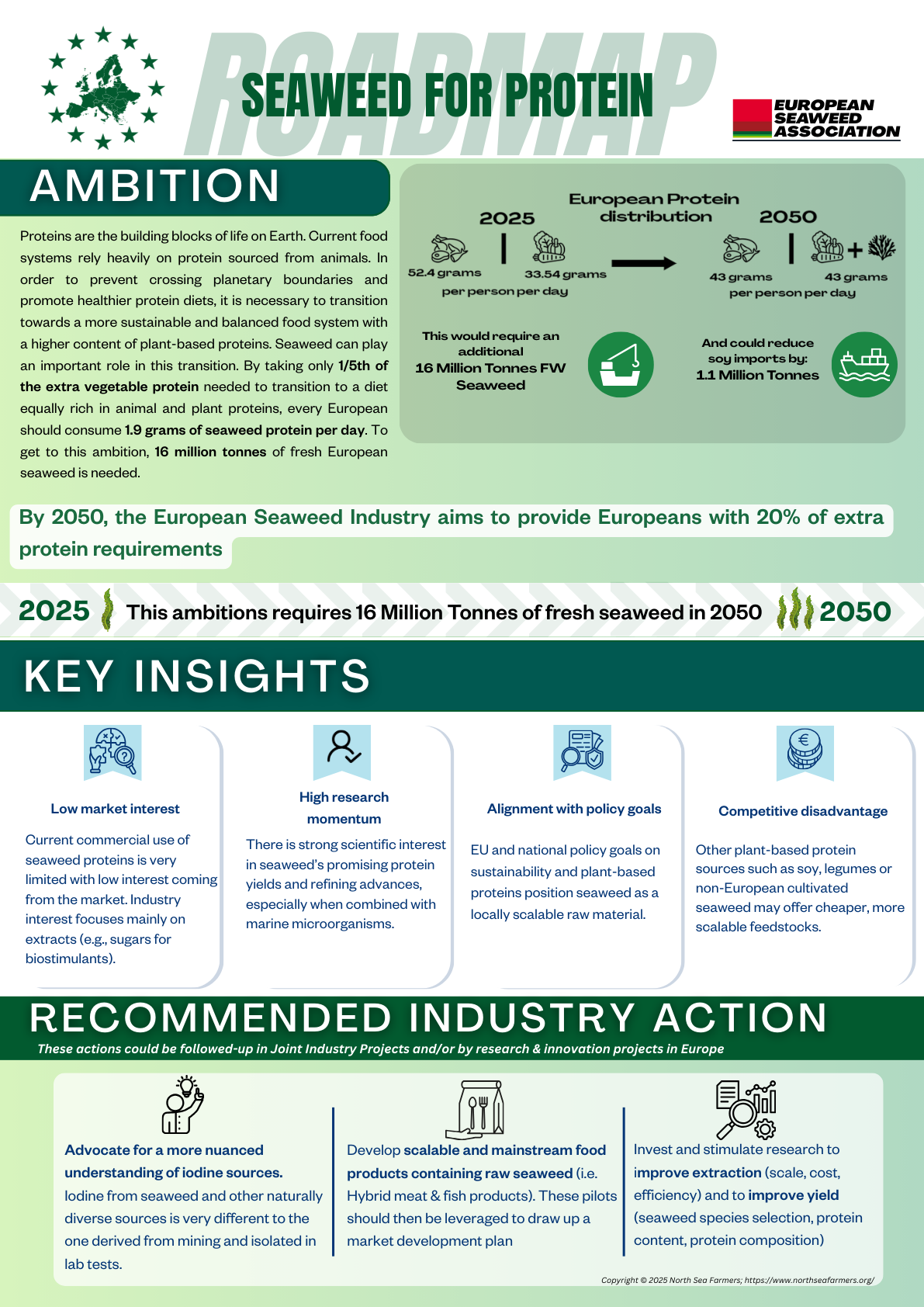 The urgency to transform food systems is great. Seaweed is seen as a potentially sustainable source of plant-based proteins for the protein transition. The province of Zuid-Holland has asked the European Seaweed Association to investigate whether and how seaweed proteins can contribute to healthier and more sustainable food systems with the central question: can seaweed play a significant role in the protein transition for a healthier and more sustainable food system, and if so, how?
Through extensive market analysis, interviews with stakeholders, and literature review, this roadmap sets out the following ambition: by 2050, the European seaweed industry will provide one fifth of the extra vegetable proteins needed for Europeans. By then, vegetable proteins will comprise half of all daily protein intake for Europeans. To achieve this target, some 16 million tonnes of fresh seaweed per year will be needed by 2050. Important bottlenecks are identifying (and breeding) the right seaweed species and reducing their production costs (e.g. with a production subsidy). The biggest opportunity lies in the further development and scaling up of hybrid meat products with seaweed.
Download the one pager


DOWNLOAD THE FULL ROADMAP